
Easier Mealtimes With Less Frustration.
Mealtimes should be enjoyable, not stressful. Yet for many older adults, simple tasks like keeping a bowl steady or scooping food onto a spoon can become surprisingly difficult.
Conditions such as arthritis, Parkinson’s disease, hand tremors, stroke recovery, and reduced grip strength can make traditional dishes harder to use. Bowls may slide across the table, plates can tip, and food often ends up on the table instead of the fork.
While these challenges may seem minor, they can affect independence and confidence. Some seniors begin relying on caregivers for help during meals, while others simply avoid foods that are difficult to manage.
Spill-resistant bowls and dishes are designed to solve these problems. Features such as suction bases, raised edges, non-slip bottoms, and scoop-style designs can make eating easier while reducing messes and frustration.
In this guide, we’ll look at how adaptive dinnerware works, who may benefit from it, and what features to consider before making a purchase.
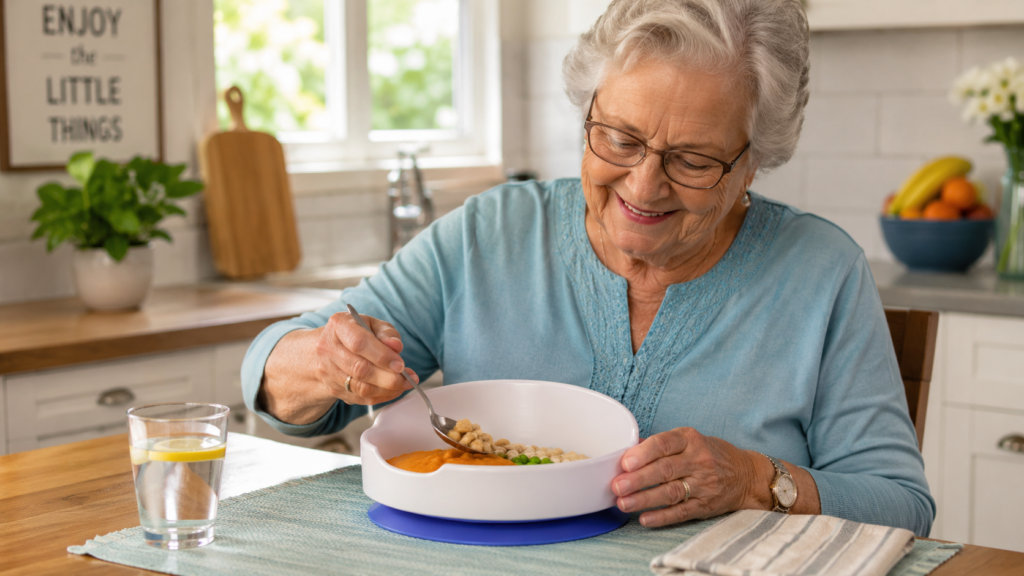
Why Eating Can Become More Difficult With Age
Many age-related conditions affect hand strength, coordination, and mobility.
Common challenges include:
- Arthritis causing pain and stiffness in the fingers
- Parkinson’s disease creating tremors and reduced control
- Stroke recovery affecting one side of the body
- Reduced grip strength due to aging
- Vision changes that make food harder to see
- Muscle weakness that affects stability
These issues can turn everyday meals into a challenge.
A plate that moves while someone is trying to cut food can quickly become frustrating. Likewise, a bowl that slides away when scooping soup or oatmeal may make eating independently difficult.
Fortunately, adaptive dinnerware is designed specifically to address these common problems.
How Spill-Resistant Dinnerware Helps
Unlike traditional dishes, adaptive bowls and plates are designed with stability and ease of use in mind.
The goal is not simply to prevent spills but also to help seniors maintain independence.
Common Features and Benefits
| Feature | Benefit |
|---|---|
| Suction Base | Helps prevent sliding and tipping |
| Raised Edge | Makes scooping food easier |
| Scoop Design | Guides food onto utensils |
| Non-Slip Bottom | Improves stability on tables |
| Lightweight Material | Easier to lift and handle |
| High-Contrast Colors | Helps those with vision difficulties |
Even one or two of these features can significantly improve the dining experience for some seniors.
Types of Spill-Resistant Bowls and Dishes
Not every senior has the same needs. Understanding the different types available can help narrow the search.
Scoop Bowls
Scoop bowls feature a higher sidewall that allows food to be pushed onto a spoon or fork more easily.
These are often recommended for individuals who eat with one hand following a stroke or injury.
Suction Bowls
Suction bowls attach firmly to smooth surfaces.
They are especially useful for seniors with hand tremors or reduced coordination because they stay in place during meals.
High-Rim Plates
These plates include raised edges that act as a barrier when scooping food.
The design helps keep food on the plate instead of being pushed over the side.
Divided Plates
Divided plates separate different foods into sections.
This can be helpful for seniors with low vision or coordination difficulties.
Recommended Spill-Resistant Bowls and Dishes for Seniors
Providence Spinal Pneu-Scoop Bowl
This adaptive bowl is designed for individuals who have difficulty stabilizing dishes while eating.
Its suction base helps keep the bowl securely in place, while the elevated back wall makes it easier to gather food onto a spoon without assistance.
Best For: Stroke survivors, severe hand weakness, and one-handed eating.
What We Like
- Secure suction base
- Deep scoop design
- Durable construction
- Helpful for one-handed use
Possible Drawback
- May feel too deep for some meals
⇒ See your choice of adaptive dining bowls here.
Maddak Scoop Dish with Suction Base
This dish combines the convenience of a plate with the support of a raised rim.
The design allows food to remain accessible while helping prevent spills and sliding.
Best For: Seniors with arthritis, mild tremors, and reduced hand control.
What We Like
- Raised edge helps with scooping
- Stable suction base
- Easy to clean
- Familiar plate-like design
Possible Drawback
- Suction may not work as well on textured surfaces
⇒ See your choice of spill-resistant dishes here.
Can’t find it in stock?
⇒ Browse similar adaptive dining dishes on Amazon.
Comparison Table
| Product | Best For | Suction Base | Raised Edge | One-Handed Eating |
|---|---|---|---|---|
| Providence Pneu-Scoop Bowl | Stroke recovery | Yes | High | Excellent |
| Maddak Scoop Dish | Arthritis | Yes | Moderate | Good |
Features to Look for Before Buying
Choosing the right dinnerware depends on the user’s specific needs.
Stability
A bowl that stays in place is often the most important feature for seniors with tremors or limited hand strength.
Raised Sides
Higher sides make it easier to scoop food without pushing it off the plate.
Weight
Very heavy dishes can be difficult for some seniors to lift.
Look for products that balance stability with ease of handling.
Ease of Cleaning
Dishwasher-safe materials save time and simplify daily use.
Visibility
High-contrast colors may help individuals with vision changes identify food more easily.
Common Mistakes to Avoid
Many families purchase adaptive dinnerware without considering how it will actually be used.
Some common mistakes include:
- Choosing dishes that are too heavy
- Ignoring suction or non-slip features
- Buying bowls that are too deep
- Selecting products that are difficult to clean
- Purchasing large sets before testing a single item
Starting with one bowl or plate often makes it easier to determine what works best.
Frequently Asked Questions
Do spill-resistant bowls really work?
Yes. While no bowl can completely prevent every spill, designs with suction bases and raised edges can significantly reduce common mealtime accidents.
Are suction bowls dishwasher safe?
Many are, but always check the manufacturer’s instructions before placing them in the dishwasher.
What type of bowl is best for Parkinson’s disease?
Many individuals with Parkinson’s benefit from bowls with suction bases and raised sides because they help reduce movement and make scooping easier.
Can adaptive dishes help stroke survivors?
Yes. Scoop bowls and high-rim plates are often recommended for people who eat primarily with one hand following a stroke.
Are spill-resistant dishes only for seniors?
No. They may also help children, individuals with disabilities, and anyone with limited hand coordination.
Final Thoughts
Spill-resistant bowls and dishes can make a meaningful difference for seniors who struggle with tremors, arthritis, reduced hand strength, or mobility challenges.
The right adaptive dinnerware can reduce frustration, improve independence, and help make meals more enjoyable. Features such as suction bases, raised edges, and scoop-style designs are often simple solutions to everyday problems.
Choosing the best option depends on individual needs, but even a small change in dinnerware can make mealtimes easier and more comfortable.
Simple changes can make everyday life easier and safer,
You may find our article on simple home changes helpful.
Simple Home Changes That Make Life Easier After 50 (Without Making Your Home Look Medical)
Affiliate Disclosure:
Some links in this article may be affiliate links. As an Amazon Associate, PowerAt50Plus earns from qualifying purchases at no extra cost to you.
Sam Ammouri